HOTEND / Printers
A Fiber-Optic Print Head Makes a Half-Millimeter Benchy
Vik Olliver’s RepRapMicron uses a UV LED and an optical patch cord to cure tiny resin structures, with a familiar slicer supplying the toolpaths.
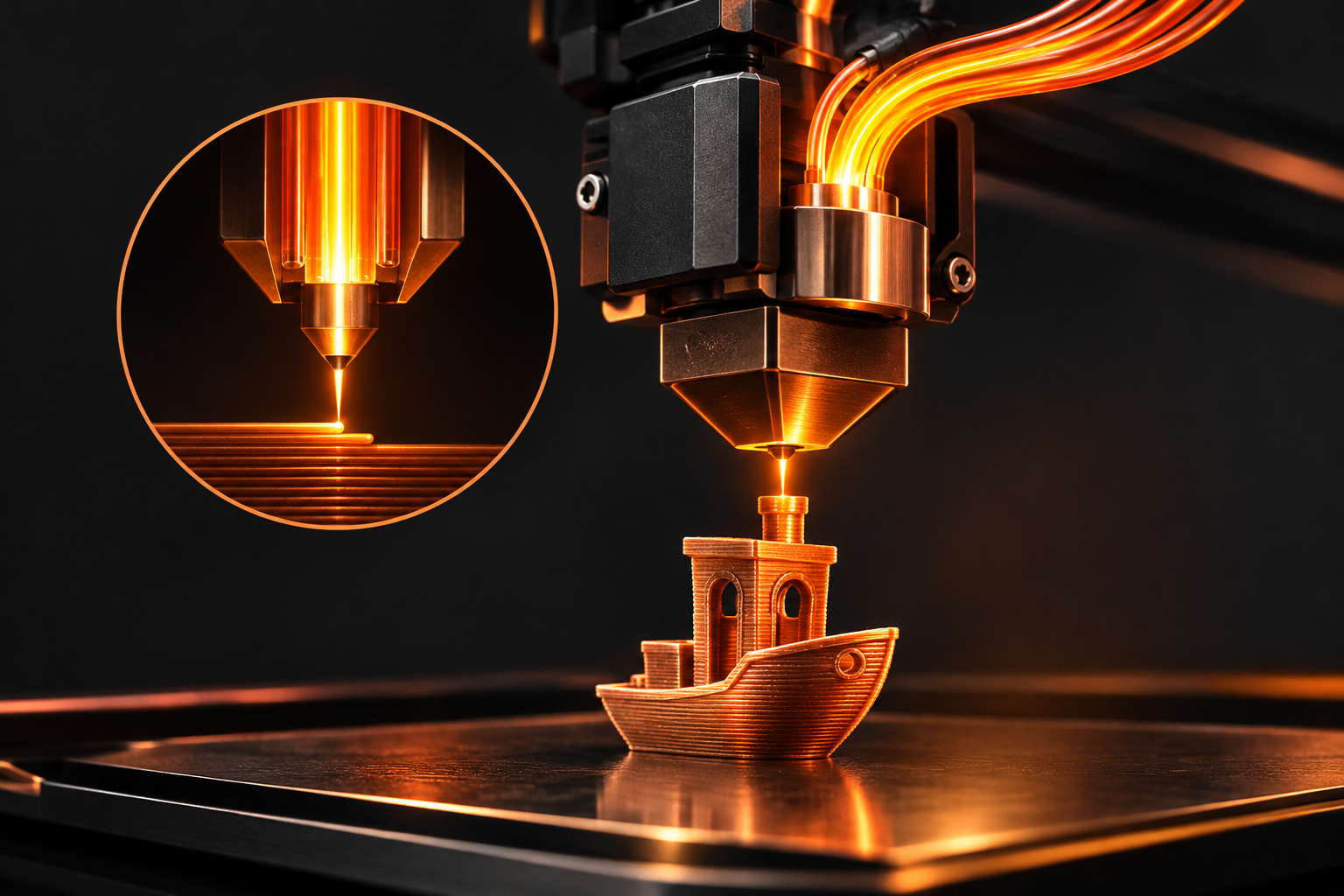
The Benchy on Vik Olliver’s print bed is just 0.5 millimeters long. It was made not by projecting an entire resin layer, but by moving the end of an optical fiber through a droplet and curing material with UV light. The RepRapMicron project wiki shows the little boat and lists a 4-micrometer layer height.
Olliver’s open-source μRepRap project explores fabrication at a much smaller scale than an ordinary desktop RepRap. Its PIKA machine uses 3D-printed flexure mechanisms for fine movement. The project reports approximately 1-micrometer repeatable positioning and an approximately 8-millimeter cubic working volume; separately, it reports curing resin lines 9 micrometers wide with the fiber probe. Those figures describe different aspects of the machine, not a guaranteed resolution for every feature of the Benchy.
The UV head build notes describe a single-mode 9/125-micrometer network patch cord, separated from its duplex partner with a hacksaw. A printed adapter aligns one end with a UV LED module; the other becomes the moving probe. The example uses a RAMPS controller’s coolant-mist output to switch the light. Olliver questions the LED module’s advertised 3-watt rating, and notes that the series resistor in his setup gets very hot.
The software workaround is as interesting as the hardware. A Python filter converts PrusaSlicer output into movements and light-switching commands: moves that would extrude instead turn on the UV source. Because the slicer cannot directly accommodate such a tiny nozzle, the workflow slices at an enlarged scale and converts the coordinates for the controller.
There are practical limits. Olliver says light can cure resin roughly 100 micrometers deep, making overhangs difficult; the notes suggest experimenting with a UV-absorbing dye. After printing, the delicate part must be washed and fully cured, and resin must be cleaned from the fiber tip to prevent buildup. The documentation also warns against looking into the UV source.
Sources.
Original reporting, references, and further reading.