HOTEND / Materials
A Recycled Filament Designed to Give Printed Prosthetic Hands a Touchscreen-Friendly Fingertip
University of Guadalajara students are developing Filna, a recycled-plastic filament with an intended job beyond providing structure: helping a printed hand interact with phones and tablets.
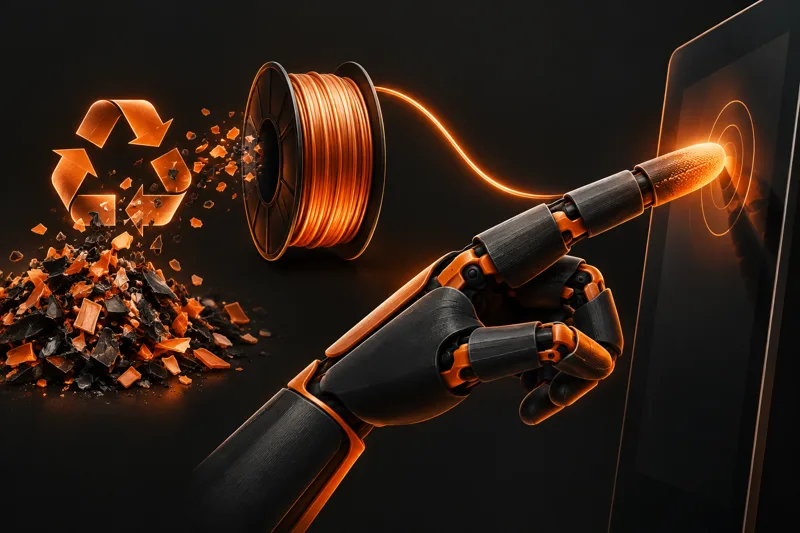
A printed prosthetic fingertip could do more than provide a gripping surface: it could also be a way to operate a phone. That is the idea behind Filna, a recycled-plastic filament being developed by students at the University of Guadalajara in Mexico.
The university’s account of the project says Filna combines recovered plastic with nanomaterials to add a function beyond the material’s structural role. Team member Uriel Aranda Rodríguez says those additives give the material the potential to interact with mobile-device screens. The university does not describe a touchscreen test or provide results, so it is not yet clear how reliably a printed prosthetic finger performs in use.
Aranda Rodríguez, a biomedical technologies student, works on Filna with Rodolfo Yael Ibáñez Rodríguez, Brenda Lucía Muñoz Sánchez and Eduardo Cornejo Magdaleno. The team comes from the university’s Guadalajara and Tonalá centers. Its proposal won first place in the Next Gen category at Enactus Mexico’s national competition in August 2026.
From a printed hand to the material itself
The team initially focused on printing prostheses, according to Aranda Rodríguez. It shifted toward filament development after encountering the expense of prostheses and the difficulty some people face in obtaining them. The aim is to make a material that could contribute to an alternative, while addressing an everyday task that a hand prosthesis might need to perform.
To make the filament, the students sourced plastic for recycling, shredded it, applied heat and added nanomaterials. The university does not identify the plastic or additives, give their proportions, or explain the electrical mechanism in detail. Those omissions matter to anyone hoping to reproduce the blend: there is no verified recipe or set of print settings to follow.
The broader design problem is real, though. A separate 2023 engineering research paper notes that insulating materials in upper-limb prostheses can make capacitive touchscreen interaction difficult. That project explored a conductive polymer intended for a fingertip pad. It is unrelated to Filna, but it shows another way to approach the same challenge: put the screen-interaction function where the device touches the glass.
For a maker, Filna’s interesting proposition is to incorporate that extra function into a printable material rather than treat a prosthetic hand solely as a shaped mechanical part. Whether the material could be used just at a fingertip, throughout a hand, or in another configuration is not specified in the university report.
What remains to be established
The report also does not provide strength, wear, electrical-performance or skin-contact data, nor does it compare the cost of a finished Filna prosthesis with other options. Recycled feedstock alone does not establish the price, fit or durability of a complete device. Those are important questions before drawing conclusions about accessibility or use by a person who needs a prosthesis.
The team is continuing work with mentors Jacob Durán and Alejandro Campos. The university says the students are exploring fluorescent properties for possible medical applications and biodegradability; these are development goals, not established features of the touchscreen material.
For now, Filna is a useful material-design idea with a clear practical target. The next meaningful step for makers and potential users is evidence of how a printed part performs—both against a screen and as part of a durable, comfortable prosthetic device.
Sources.
Original reporting, references, and further reading.