HOTEND / More stories
A Satellite Printed a 30-Centimeter Boom in Space, One Spiral at a Time
Orbital Matter’s Replicator 2 used UV-cured resin to make a hollow structural boom in orbit. The experiment points toward solar arrays supported by structures printed after launch.
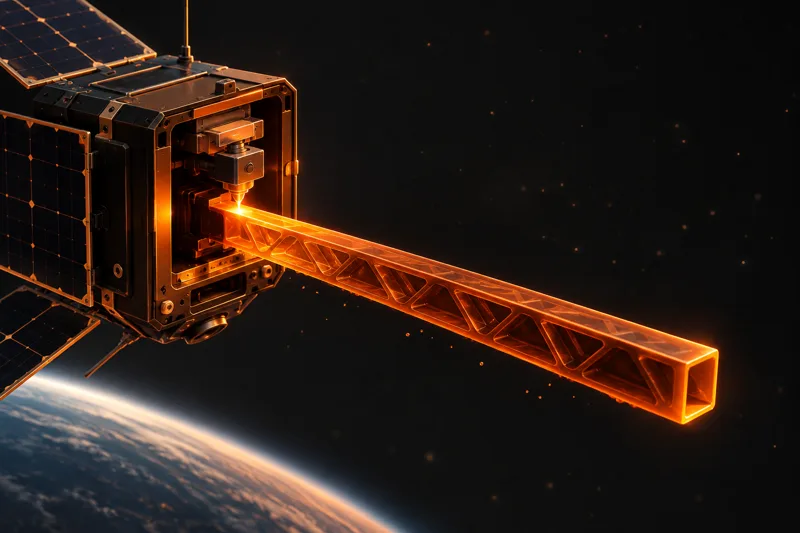
A printer aboard a small satellite spent about half an hour making a hollow boom that extended 30 centimeters into space. There was no enclosure around the print: the resin was extruded and cured in the vacuum outside Orbital Matter’s Replicator 2 spacecraft.
The October 21, 2026 print was a small-scale test of a larger idea. Instead of packing a long support structure into a rocket and unfolding it in orbit, a satellite could carry the material and print the support where it will be used. For solar arrays, the growing boom could push out a stowed blanket of cells and then hold it in place.
Orbital Matter’s mission update describes the result as its first boom produced in space. The company says the structure was continuous, with clean bonding between layers. It was the second print on Replicator 2, which launched on July 7 carrying four printers.
A different kind of resin print
The process has familiar ingredients for anyone who has worked with photopolymers: liquid resin and ultraviolet light. But rather than curing a model in a vat, the printer extrudes material and cures it as a structure grows outward. Orbital Matter says the boom is hollow and built in a continuous spiral—a geometry intended to keep it light while providing stiffness.
The hardware also has to work without a comfortable room around it. In low Earth orbit, the print is exposed to vacuum, microgravity and temperature swings. Orbital Matter’s footage and account of the first print show resin emerging from the nozzle and a UV light curing it into a solid structure.
That first run, on August 12, established that the printer could extrude and cure material in orbit, but it did not produce a fully viable structure: Payload reported gaps between the printed layers. Between runs, Orbital Matter says it analyzed the first print, adjusted parameters and improved the printer firmware. The later boom was the result of those changes.
Each printer has an inspection camera. According to the company, an image-recognition system used the camera feed to control the second print and check material as it was produced. That matters when the print is on a spacecraft rather than on a bench: an operator cannot simply reach in to inspect or correct it.
What the boom is for
The boom is a support, not a printed solar cell. The solar blanket is carried separately; the intended job of the printed structure is to deploy and support it. Payload reports that Replicator 2 partially deployed a solar array along a single boom. Orbital Matter’s own update describes boom printing as a step toward array deployment, without detailing the extent of that deployment.
The company’s next target is a 2028 mission with EnduroSat: two printers would deploy a stowed solar blanket intended to produce 5 kilowatts. That is a plan, not a result from the October test. Orbital Matter also describes longer booms and other uses, including antenna supports, in its system overview.
The practical question now is how well the process scales: a clean 30-centimeter print does not by itself establish the strength, durability or reliability of a much longer structure. Still, Replicator 2 has demonstrated a compelling maker idea in an unusual workshop—turning stored material into a useful shape at the place it is needed.
Sources.
Original reporting, references, and further reading.