HOTEND / Printers
Bambu Lab’s H3C Keeps Nine Filaments Loaded for Faster Tool Changes
Swaptek gives each print tool its own filament path and preheats the next nozzle while the current one is still working. Early testing shows the speed—and the remaining waste.
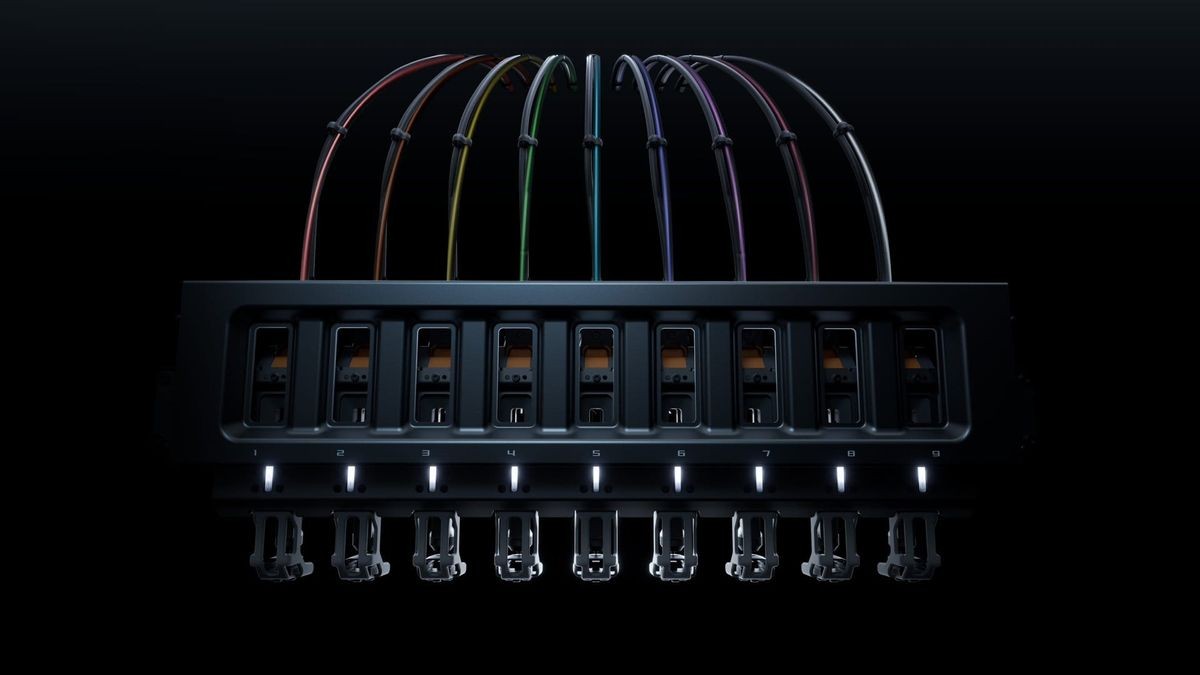
A multicolor print with more than 4,000 tool changes left almost 200 grams of material in its prime tower on Bambu Lab’s H3C. That’s a useful counterpoint to the printer’s headline feature: its Swaptek system can switch between nine loaded print tools without repeatedly unloading and reloading filament, but it doesn’t make material changes waste-free.
Announced on November 3, 2026, the H3C is built around a tool-changing approach to multi-material printing. Instead of pushing each new color through the same melt path, the printer carries separate tools, each with its own filament path and heating system. The idea is to spend less time and material preparing a nozzle for the next color—and to make combinations of materials and nozzle sizes more practical.
What happens during a change
In a conventional single-nozzle material switch, the outgoing filament has to be removed and the incoming filament fed into the hotend. The nozzle may then need purging to clear the previous material. With Swaptek, the filament stays loaded in its own tool while that tool is parked.
Bambu Lab’s explanation of the system says the printer reads ahead in the G-code and starts heating the incoming nozzle while the current one is still printing. The machine then docks the active tool, picks up the next, primes it and resumes printing. Bambu claims a print-to-print change in under six seconds.
In CNC Kitchen’s hands-on review, Stefan Hermann reported typical print-to-print changes of about six to seven seconds when a tool only needed priming. Changes took a little over ten seconds when the tool also printed the outside contour of the prime tower. Those observations give the company’s figure useful context: the time saved depends on what the printer has to do at each change.
The parked tools sit on a retractable rack at the front of the machine. Bambu says moving the rack and guide tubes improves print visibility, makes room for additional Z travel and helps prevent the tubes from knocking into one another. The AMS 3H above the printer stores and feeds nine spools; its built-in dryer handles two spools at a time, according to the company’s launch announcement.
Why separate tools matter
A dedicated tool does more than preserve a color. It can also carry a different nozzle size. Bambu describes a watch printed with a fine nozzle for dial details, another for the body and a tool feeding thicker filament for a flexible strap. Its FlexFeed extruder supports both 1.75 mm and 2.85 mm filament; the company says the thicker material is less prone to buckling when feeding soft TPU.
The distinction between fast changes and zero waste matters, though. Hermann reported roughly 50 milligrams deposited on the prime tower per change in his test. The approximately 200-gram tower for his heavily switched print shows how a small amount can accumulate. He also found that changing a spool requires an unload operation on the printer rather than simply pulling the filament out of the AMS.
Swaptek can also hold optional cutting, drawing and debossing tools. There is a workflow boundary: Bambu says 3D printing and 2D processes currently use separate software environments, so they cannot yet be combined in one job, and a suitable 2D plate must be installed.
The H3C and AMS 3H package starts at $2,499 before tax in the US. For makers considering it, the appeal is the ability to keep several materials and nozzle sizes ready in one print—not the promise that every switch is free. The prime tower, spool workflow and types of jobs you actually make are just as important to the calculation.
Sources.
Original reporting, references, and further reading.