HOTEND / Printers
Bambu Lab’s H3C pairs nine print tools with a new way to feed soft TPU
The $2,499 H3C keeps nine filament paths ready for a print, while its new extruder accepts both 1.75 mm and 2.85 mm filament.
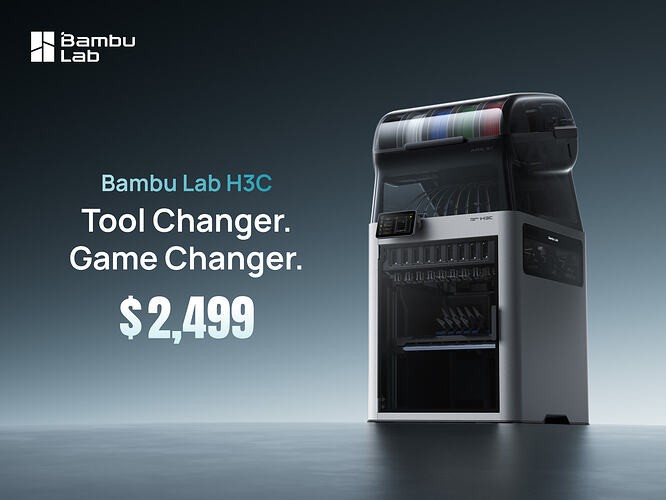
Bambu Lab’s H3C arrives with nine print tools, each with its own heater and filament path. That means a color or material change doesn’t necessarily involve pulling one filament back through a shared nozzle and feeding another in. The company says the printer can switch from printing with one tool to the next in about six seconds.
Announced on November 3, 2026, the H3C costs $2,499 before tax in the US with its AMS 3H filament system. The nine tools make it more than a multicolor machine: they can also carry different nozzle sizes and materials, including soft TPU fed through a new extruder.
Nine tools, one moving head
Bambu calls the tool-changing architecture Swaptek. Its technical explanation describes tools that remain loaded while the printer works. The software reads ahead in the print instructions and heats the incoming nozzle while the current one is still printing. A retractable rack presents the tools for automatic changes and manages their guide tubes.
That approach avoids the long unload-and-reload cycle associated with sharing a nozzle between filaments. It doesn’t eliminate all waste, though. In Tom’s Hardware’s hands-on review, Denise Bertacchi measured a roughly six-second switch and found that the printer still used a purge tower. One eight-color dragon produced 68 grams of tower waste—useful context for a system that reduces purging rather than making every print waste-free.
Different nozzle sizes offer another reason to keep several tools ready. Bambu shows a watch printed in one job with a 0.2 mm nozzle for dial details, a 0.4 mm nozzle for the body and a separate tool for a flexible strap. The idea is to use a fine nozzle where detail matters without making it print the whole object. The company lists supported nozzle diameters from 0.2 to 0.8 mm.
A thicker route for flexible filament
The FlexFeed extruder accepts both common 1.75 mm filament and thicker 2.85 mm filament. Bambu says the larger diameter helps resist buckling when feeding soft TPU; it claims up to three times the flow rate of a traditional printer with its 2.85 mm TPU. Bertacchi reported successfully printing with the company’s soft 75A material, though that test does not establish the broader speed claim.
The distinction matters when shopping for materials and tools. The review says the standard configuration includes eight 1.75 mm tools and one 2.85 mm tool, all with 0.4 mm nozzles. It also reports that soft TPU and 2.85 mm filament use bypass ports and require manual feeding, rather than the automatic loading used for standard rigid filament.
The enclosed AMS 3H holds the spools above the printer. Two slots can actively dry filament at up to 85°C, including during a print; the other slots are not heated dryers. Bambu says an older AMS can be connected through one print tool to reach up to 24 filaments, although those additional materials share that tool rather than gaining individual dedicated nozzles.
For larger functional parts, the launch specifications list a 330 × 320 × 325 mm build volume, 350°C maximum nozzle temperature and actively heated chamber up to 65°C. Plan the workspace as carefully as the print: Bertacchi found the top-mounted filament system tall enough to make rear spools difficult to reach from a standard-height counter.
The H3C’s appeal is the combination: fast tool changes, mixed nozzle sizes and a route to softer materials in one machine. Its price and physical size make it a substantial commitment, but for makers designing parts around several materials, those extra tools could be useful long before all nine are assigned a color.
Sources.
Original reporting, references, and further reading.