HOTEND / Materials
FilaLoom Brings Yarn Weaving to 3D Printing Without Extra Electronics
A printable attachment for the Bambu Lab A1 alternates between laying yarn and extruding plastic, opening up woven objects, soft surfaces, and pull-string mechanisms.
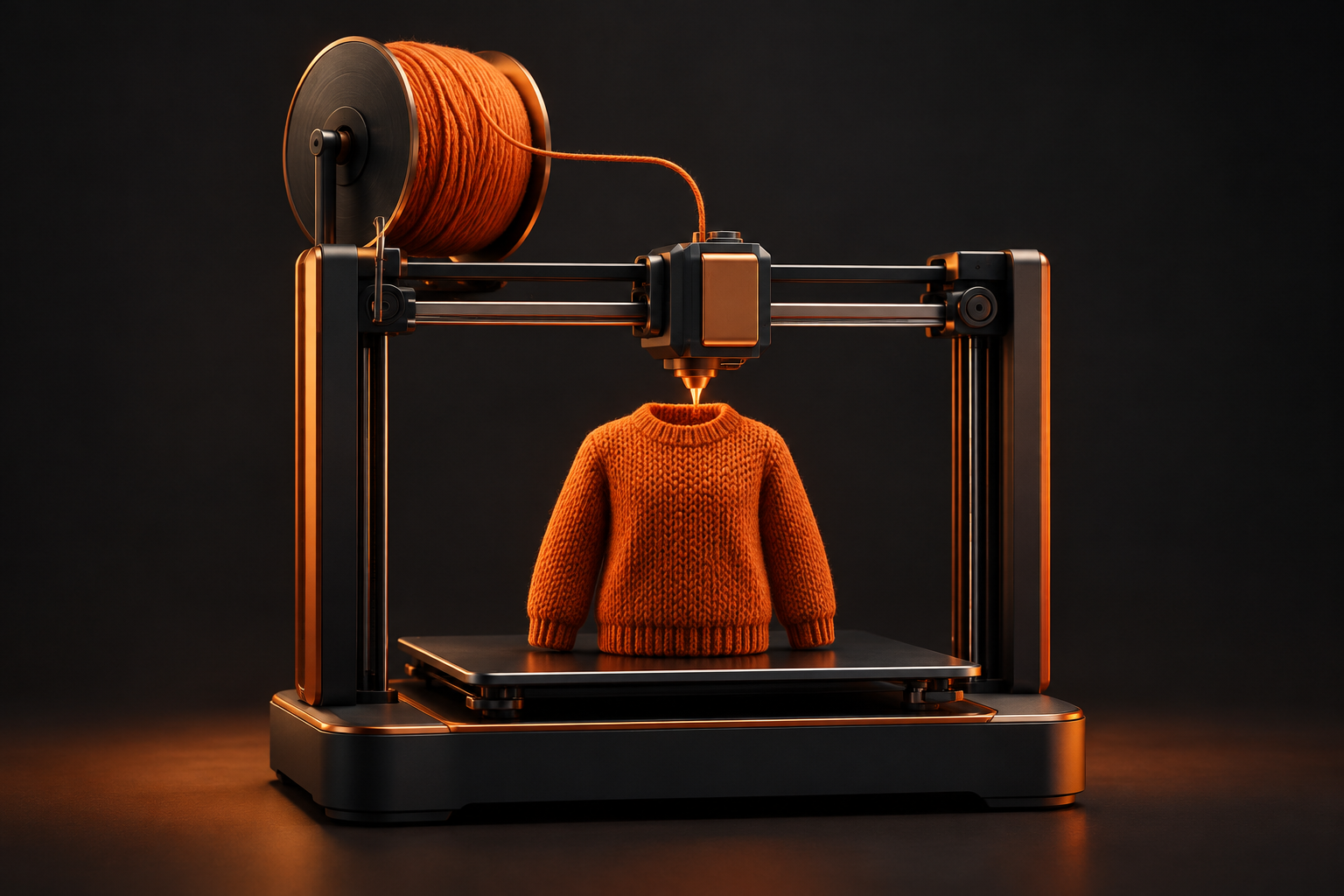
A 3D-printed textile that bends when you pull a string is one of the more intriguing samples made with FilaLoom. The string isn’t threaded through afterward: a modified printer places it during the print, alongside the plastic structure that moves around it.
FilaLoom is a yarn-depositing attachment developed by Joram de Haas for his master’s thesis at TU Delft. In a research preprint, de Haas and collaborators Mehmet Ozdemir, Holly McQuillan, and Zjenja Doubrovski describe a prototype for the Bambu Lab A1. It uses the printer’s existing motion system rather than adding electronics.
The process starts with printed anchor points. The print head picks up a parked yarn depositor, moves it between those anchors, then returns it to its station. Printing can then resume, sometimes laying plastic over the yarn to hold it in place. A spring-loaded spool supplies adjustable tension, while a blunt dispensing needle guides the yarn.
The samples are closer to weaving and yarn embedding than conventional knitting. They include a bowl with alternating colors woven around printed pillars, flexible sheets made from TPU and cotton yarn, and soft yarn-covered surfaces. The cable-driven samples show another possibility: yarn can run through a printed channel so that pulling it bends or coils a textile-like sheet.
Makers can find printable component files and Grasshopper scripts in the project repository. This is an experimental workflow, though, not a standard slicer preset. Some scripts generate complete G-code; the surface-texture and cable-driven methods also require manually inserting weaving instructions into sliced G-code.
There are hardware tradeoffs, too. The researchers calculate that the area where the A1 can both print and weave is 54% of its original build volume. Too much yarn tension can deform a part or pull it off the bed, and the attachment doesn’t cut yarn automatically. Those constraints are worth planning around, but the payoff is a way to explore parts where the thread contributes more than color.
Sources.
Original reporting, references, and further reading.