HOTEND / Materials
Prusa’s 400°C Hotend Opens Up PPS Printing, but the Chamber Still Sets Limits
The CORE One upgrade adds higher nozzle temperatures and new material options. Getting useful results also means paying attention to the extruder, print surface, drying and ventilation.
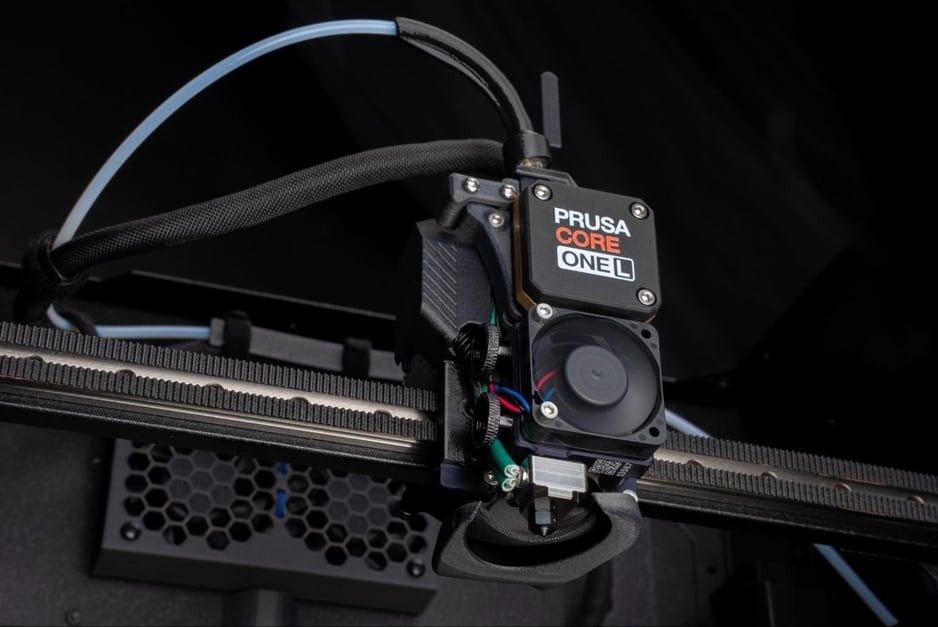
A nozzle that reaches 400°C can melt filaments that are out of reach for many desktop printers. But on Prusa’s CORE One family, the temperature around the part—not just the temperature inside the nozzle—will still determine how far those materials can go.
Prusa Research’s HT Hotend is now available as an upgrade for the CORE One, CORE One+, CORE One+ Gen 2, CORE One L and CORE One L+. The company also offers a CORE One L+ with the hotend factory-installed. Prusa announced its availability on October 21, after previewing the upgrade at Formnext in 2025. The hotend is not compatible with the INDX multi-material system.
The upgrade gives makers a route into materials including carbon- and glass-fiber-filled PPS and carbon-fiber-filled PPA. Prusa has added examples of all three to its shop. Those filaments are aimed at functional parts where heat, chemicals or wear matter more than the easy handling of PLA. As always, the requirements of a particular part should guide material choice; a filament’s headline properties are not a guarantee that every printed part will achieve them.
The hotter nozzle may also be useful with materials CORE One owners already print. Prusa says its measurements showed interlayer adhesion increases of 23% for Prusament PA11 Carbon Fiber, 18% for ASA and 7% each for PC Blend and PC Blend Carbon Fiber when printed using higher temperatures. Those are manufacturer-reported results, not a promise of the same improvement for every geometry or print setup.
More than a nozzle swap
The upgrade kit comes with a hardened 0.4 mm E3D ObXidian 500 nozzle, a replacement main plate and two extruder idlers. Prusa describes the hotend itself as quick to swap, but the initial installation is a bigger job: its installation guide includes replacing the main plate and recalibrating the printer.
After installation, the idlers can be changed without disassembling the extruder. Prusa’s usage guide calls for the modified “H” idler with materials such as PPS-CF and PPS-GF, and the standard “S” idler for materials including ASA and PA11-CF. It also specifies compatible ObXidian Standard Flow 500 nozzles; ordinary Prusa, high-flow and standard ObXidian nozzles are not approved for the HT hotend.
The rest of the setup matters
Prusa also offers HighTemp sheets sized for the CORE One and CORE One L. The surface is intended for demanding materials including PPS, rather than as an all-purpose replacement for a familiar sheet. The company says ordinary materials such as PLA and PETG are unsuitable for it. One easily missed detail: the sheet’s care instructions say to use dish soap and water, not IPA or acetone, which can damage the coating.
Filament preparation and emissions deserve space in the plan, too. Prusa recommends drying hygroscopic materials according to the filament maker’s instructions and keeping them dry during printing. It also recommends filtration for high-temperature materials because of their emissions, or connecting the printer’s rear exhaust to an HVAC system.
Finally, 400°C at the nozzle does not mean a 400°C build environment. Prusa identifies the CORE One’s chamber temperature—up to 60°C—as a constraint for materials such as PEKK-A CF, which may need a hotter environment; small parts may still be possible. For makers weighing the upgrade, its appeal is the broader choice of materials and profiles, while the chamber, surface and handling requirements remain part of the decision.
Sources.
Original reporting, references, and further reading.
- 400°C HT Hotend is out! Plus: New Materials and HighTemp Sheets for CORE One+/L+ ↗
- Prusa at Formnext 2025: INDX, CORE One+, HT Hotend, Silicone, Dryboxes and more! ↗
- HT Hotend Upgrade for CORE One/+ and CORE One L/+ ↗
- How to install HT Hotend Upgrade ↗
- Using the HT Hotend ↗
- CORE One L HighTemp Print Sheet ↗