HOTEND / More stories
The Air Force Wants to Test 3D-Printed Walls Against Blast and Fragmentation
A new research solicitation pairs mobile concrete printing with protective geometry, local materials, and a practical question: can a small engineering crew make the whole process work in the field?
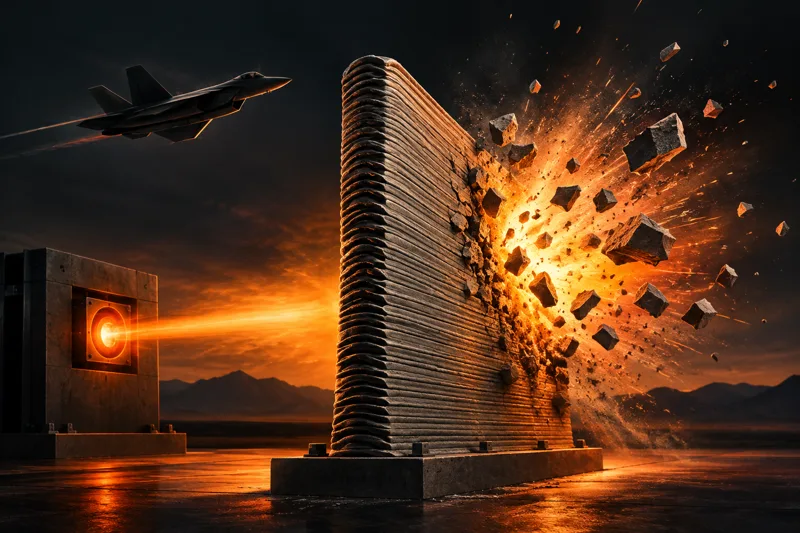
The Air Force wants more from a concrete printer than a wall that stands up: it wants printed shapes that could help protect the people behind them from blast pressure and fragments. A new research solicitation calls for those shapes to be modeled, printed, and tested—not simply shown off as an attractive alternative to a flat wall.
The Mobile Expeditionary 3D Concrete Printer solicitation, released November 4, 2026, asks small businesses to develop a field-operable construction system that brings together printable materials, mobile equipment, and protective designs. The Air Force says recent attacks on airbase infrastructure in the Middle East have underscored the need for buildings that can be put up quickly and offer more protection than typical temporary facilities.
This is a research request, not an announcement that a blast-resistant printed shelter is ready to deploy. Applications open December 2, 2026, and are due January 6, 2027. The solicitation calls for a direct-to-Phase II effort: it starts from existing work in concrete printing and asks participants to develop and test it further.
The printer is only part of the problem
Construction-scale concrete printing follows a familiar additive principle: material is deposited in successive layers according to a digital design. But instead of a spool and a desktop machine, the process involves equipment to mix, pump, and place a cement-based material at building scale.
For this project, the Air Force wants researchers to examine how candidate mixes behave throughout that process. The list includes pumpability, printability, strength gain, curing, and adhesion between layers. Those are connected requirements: a mix needs to move through the equipment, hold its shape after deposition, and develop useful properties as it cures.
The solicitation also asks teams to evaluate whether local materials can replace some ingredients where practical. That could reduce dependence on transported supplies, but a locally adapted mix still has to pass the same printing and performance checks. Researchers are expected to document validated print parameters rather than assume a recipe will work everywhere.
Geometry is the other major variable. The Air Force wants candidate forms intended to reduce blast reflection and pressure amplification or interrupt fragment paths, followed by structural, blast, and fragmentation testing. The requested deliverables include printed test articles, test results, operator procedures, and a report on limitations and follow-on work. The document does not identify a finished shape or claim that one has already met the project’s goals.
Earlier experiments provide a starting point
The Air Force has been working with construction printing for several years. Its 2024 civil engineer lab update described a printed barracks hut at Tyndall Air Force Base, Florida, being evaluated for uses that included expeditionary construction and blast protection.
Separately, the Maryland Air National Guard’s 175th Civil Engineer Squadron demonstrated an X-Hab concrete printer in May 2024. Those earlier efforts show that the machines and full-scale printed structures are real; they do not establish that the new solicitation’s protective system has been validated.
For makers, the interesting thread is how much of the design sits outside the toolpath. Material consistency, layer bonding, geometry, transport, setup, and inspection all have to work together. The Air Force’s goal is a process lightly trained crews can repeat in difficult conditions—not merely one successful print. The coming tests will determine how much of that goal can be turned into a usable construction method.
Sources.
Original reporting, references, and further reading.